The Hidden Cost of Manual USCIS Form Preparation for Immigration Law Firms
Manual USCIS form preparation costs more than staff time. It creates repeated data entry, missed information, review delays, and inconsistent workflows that slow immigration law firms down.
For many immigration law firms, manual USCIS form preparation looks manageable at first. A paralegal opens a form, copies client details from intake notes, checks an older case file, asks for missing information, and prepares the next draft for attorney review.
The problem is that this process repeats across forms, clients, and case types. Names, addresses, dates, family details, employment history, and other client information are re-entered again and again. Even when the firm has strong staff and careful review habits, manual repetition creates a quiet operational cost that compounds over time.
That cost is not only about how long one form takes. It also affects case throughput, staff capacity, consistency, and how quickly the legal team can identify missing information before preparation stalls.
Manual form preparation creates more work than the form itself
Immigration form preparation rarely starts from a clean, complete data set. Client information may live in intake responses, emails, PDFs, scanned documents, spreadsheets, case notes, prior forms, and staff memory. When each new form requires the team to gather and retype that information, the firm pays for the same work multiple times.
That repeated work often shows up in small moments: copying an address again, checking whether a date matches a prior filing, re-entering family details, or updating a field in several places after the client sends a correction. Each task may take only a few minutes, but the cumulative burden across an active caseload can be significant.
The real cost is delay, not just data entry
Manual entry also creates waiting time. When a staff member discovers that a field is incomplete, the form may sit until the client responds or the team checks another source. If the missing detail is found late in the workflow, it can delay review and create last-minute back-and-forth.
For busy firms, these delays make scheduling harder. Paralegals spend time chasing information instead of moving cases forward. Attorneys may receive drafts with unresolved gaps. Managers have less visibility into which matters are ready for review and which ones are blocked by missing client details.
Copy-and-paste workflows increase inconsistency risk
Copying information from one place to another is familiar, but it is not a scalable workflow. Every manual transfer is an opportunity for inconsistent formatting, outdated client data, or mismatched details between forms. Even with careful review, the team still has to spend time checking whether repeated fields match the firm's source information.
Immigration teams already know that legal judgment and attorney review remain essential. The question is whether attorneys and senior staff should spend as much time catching administrative inconsistencies that could have been reduced earlier in the preparation process.
A reusable client profile changes the workflow
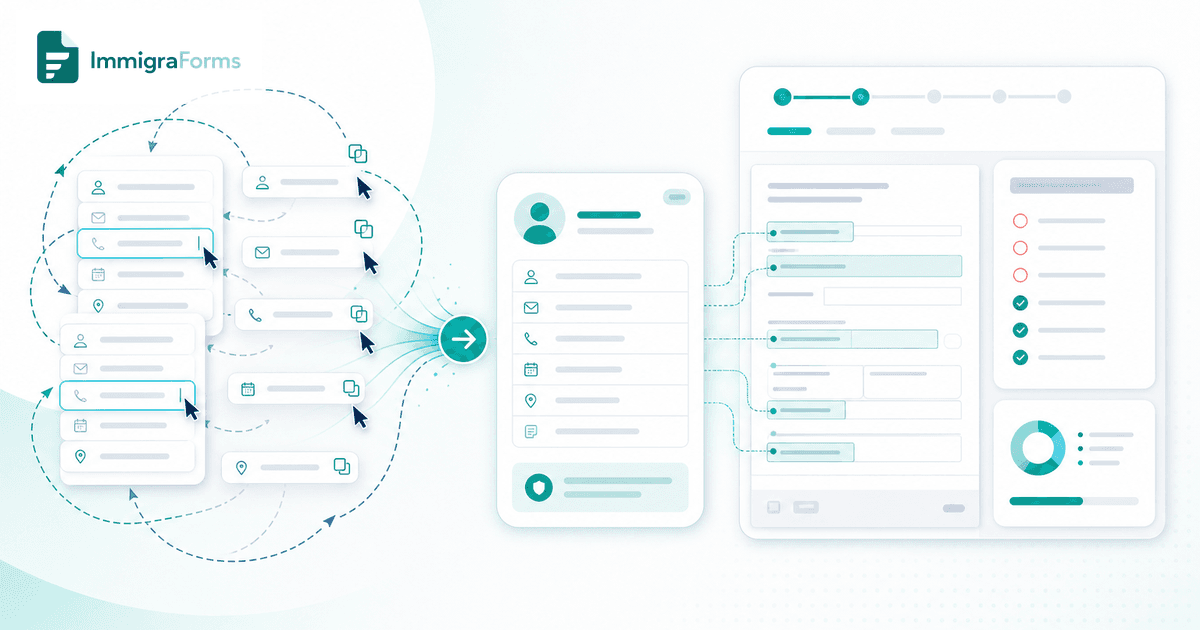
A more efficient approach starts with a reusable customer or client profile. Instead of treating every USCIS form as a separate data-entry project, the firm maintains structured client information once and reuses it when preparing future forms for that customer.
Profile data can come from intake, from forms already completed for the same customer, or from updates collected during the preparation workflow. When the team generates another form, reusable profile information can pre-fill the relevant fields, giving the legal team a faster starting point for review.
This does not remove attorney oversight. It gives attorneys, paralegals, and legal operations teams a cleaner preparation layer so the review process can focus more on judgment, completeness, and case-specific details instead of repeated typing.
Missing-information visibility matters before review
One of the biggest benefits of a structured profile-based workflow is earlier visibility into gaps. If the system can show which client details are missing before a form is generated or reviewed, the team can request information sooner and avoid discovering avoidable gaps at the end of the process.
For paralegals and legal assistants, this creates a more predictable workday. For managing attorneys, it creates a clearer view of operational bottlenecks. For clients, it can mean fewer fragmented requests for the same information across the life of a matter.
What immigration firms should look for in form preparation software
When evaluating immigration form preparation software, firms should look beyond whether the software can fill a PDF. The stronger question is whether it reduces repeated work across the firm's actual workflow.
- Reusable client profiles: Can the firm store client information once and reuse it across future forms?
- Multiple data sources: Can profile data come from intake and from forms already completed for the same customer?
- Familiar form review: Can staff see pre-filled information directly over the familiar form layout they already recognize?
- Missing-data visibility: Can the team see incomplete information before it slows down preparation?
- Attorney-reviewed workflow: Does the software support legal-team review instead of trying to replace it?
ImmigraForms helps firms reduce repetitive preparation work
ImmigraForms is designed around a practical idea: immigration law firms should not have to retype the same client information from form to form. The platform helps teams organize reusable client profile data, prepare immigration forms faster, and view pre-filled data over the familiar form layout for legal-team review.
For firms dealing with repeated entry, incomplete information, and manual preparation bottlenecks, the goal is not to remove the attorney from the process. The goal is to give the team a more efficient preparation workflow so attorneys and staff can spend less time on administrative repetition and more time on review, strategy, and client service.
Next step
If repetitive data entry is slowing your immigration form workflow, ImmigraForms can help your team move from scattered client information to faster, attorney-reviewed form preparation.