Why immigration forms software matters now
Immigration law firms rarely struggle because the team does not know which information belongs on a form. The bigger operational problem is that the same client details often appear across intake notes, case files, prior forms, spreadsheets, PDFs, and follow-up emails. Every time a paralegal retypes a name, address, travel date, family detail, or employment history into another immigration form, the firm spends valuable staff time on work that should be easier to reuse.
Good immigration forms software helps law firms move from scattered client information to a more organized, attorney-reviewed preparation workflow. Instead of treating each form as a blank starting point, the right system gives the team a reusable client profile that can support future USCIS form preparation for the same customer.
Start with a reusable client profile
The strongest foundation is a single customer or client profile. A reusable profile lets the firm store core information once, then use it when preparing additional immigration forms. Profile data can come from client intake, from information entered while working on a form, or from forms already completed for that customer.
This matters because immigration cases are rarely one-form workflows. A client may need related forms over time, updates to biographical details, or additional family, employment, travel, and address information. Software that preserves reusable data helps the team avoid rebuilding the same record again and again.
Look for familiar form previews, not just generic fields
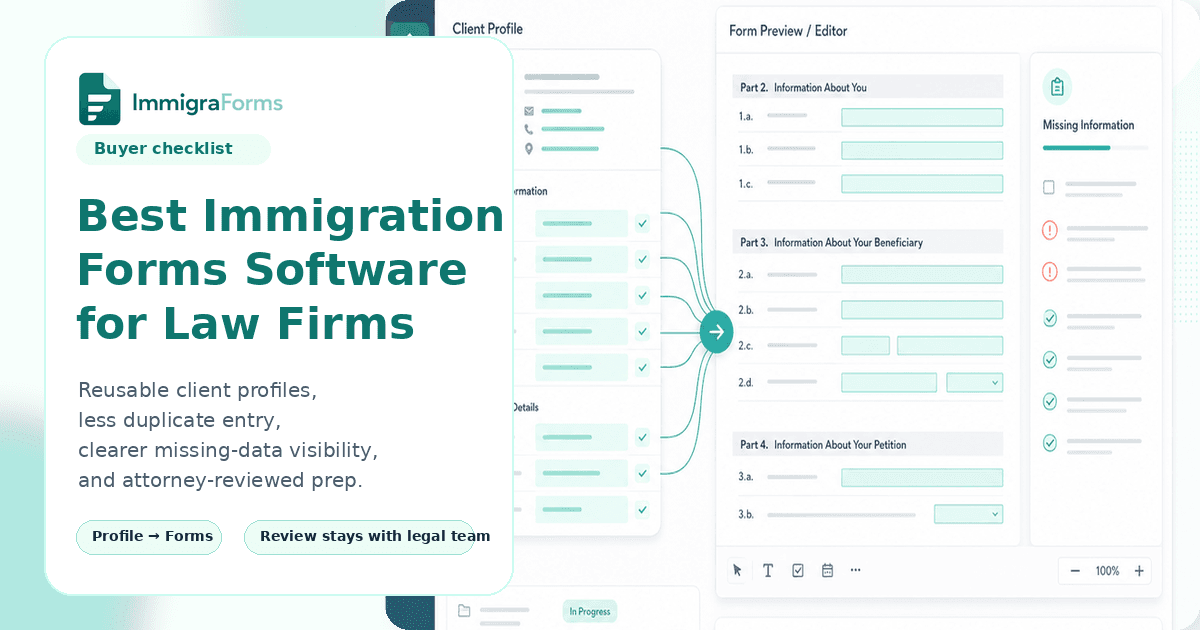
Immigration teams are used to working with real form layouts. A useful form preparation tool should make it clear where profile data will appear on the familiar immigration form, not hide everything behind generic database fields. Seeing pre-filled data directly over a recognizable form layout makes review easier for attorneys, paralegals, and support staff.
For busy firms, this can reduce the friction between data collection and legal-team review. The team can see what is filled, what still needs attention, and where information flows before a form is finalized for the firm's normal review process.
Prioritize missing-information visibility
Incomplete client information is one of the quietest causes of form-preparation delays. A form may appear nearly ready, but one missing date, address, relationship detail, or supporting data point can interrupt the workflow and trigger another round of client follow-up.
The best immigration forms software should help the team spot missing information early. This does not replace legal judgment or attorney review. It gives the firm a clearer operational view of what is missing so staff can follow up before the gap slows down form generation or review.
Reduce duplicate data entry across the firm
Duplicate entry is expensive because it compounds. A few copied fields on one case may not feel significant, but across many clients, forms, and team members, repetitive entry becomes a major drain on paralegal capacity. It can also make quality control harder when the same client fact is stored in multiple places.
Modern immigration form preparation software should reduce this copy-and-paste cycle. When client profile data is reusable, the team can spend less time moving information between forms and more time checking completeness, reviewing details, and preparing the case file for the attorney's process.
Choose cloud-based workflows that fit how teams work
Many firms now need flexible access for attorneys, paralegals, intake coordinators, and operations staff. A cloud-based workflow can make it easier for the team to work from organized client data instead of passing files, local documents, or one-off PDFs between people.
When evaluating cloud-based immigration forms software, firms should look for practical workflow benefits: clear client records, reusable information, missing-data visibility, form previews, and a preparation process that supports review rather than bypassing it.
Keep attorney review at the center
Software should support the legal team, not replace it. Immigration form automation is most valuable when it reduces administrative friction while preserving the firm's professional review process. Attorneys and legal teams still decide what information is legally relevant, how the case should be handled, and when a form is ready for the next step.
For that reason, avoid tools that imply a form is automatically ready to file simply because fields are populated. The better standard is faster, clearer preparation for attorney-reviewed completion.
A practical evaluation checklist
- Does the software use a reusable client profile as the source of future form data?
- Can information come from intake and from forms already completed for the same customer?
- Can staff see pre-filled data on a familiar immigration form layout?
- Does the workflow make missing information easier to identify before review?
- Does it reduce repeated typing and copy/paste across forms?
- Does it support attorney or legal-team review before final use?
- Is the system easy enough for paralegals and legal assistants to adopt?
Where ImmigraForms fits
ImmigraForms is built around a reusable customer profile that helps immigration law firms prepare client forms faster. Client data can be collected through intake or added while working with forms, then reused for future form preparation. The product shows generated data over familiar immigration form layouts with field overlays, helping teams see what is filled and what still needs attention.
For firms that want to reduce repetitive entry, improve missing-information visibility, and keep attorneys in control of the review process, ImmigraForms offers a practical way to modernize form preparation without turning legal judgment over to software.
Start a free trial to see how a reusable client profile can support faster attorney-reviewed immigration form preparation.